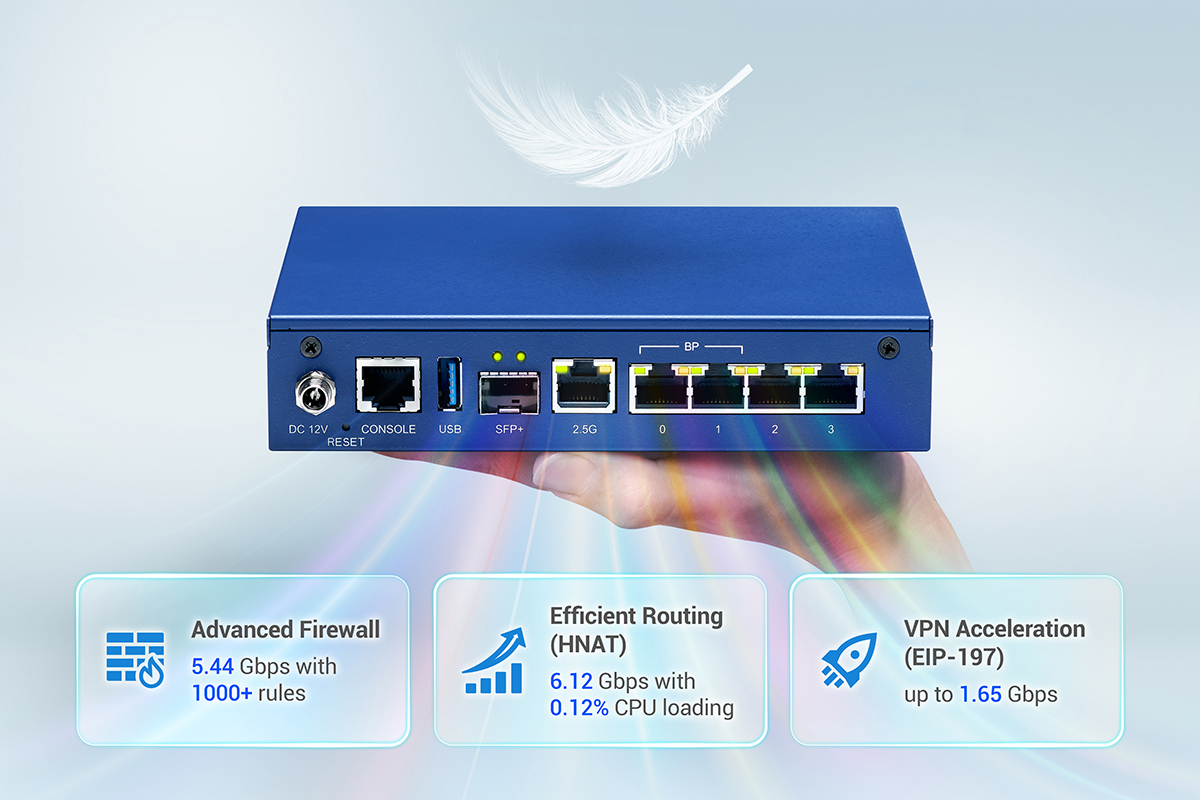

Summary
The NSA 5200 is a 1U rackmount cybersecurity appliance designed for organizations requiring real-time AI-driven threat detection across encrypted networks. Powered by 14th Gen Intel Core processors, the platform combines CPU-driven inference with optional GPU acceleration to deliver measurable performance in threat detection and machine learning workloads. The appliance serves zero-trust architecture, SASE deployments, edge computing, and cloud-native security environments with dedicated support for encrypted network monitoring and analysis.
Problem / Requirements
Organizations face escalating challenges in network threat detection at scale: legacy security appliances struggle with encrypted traffic inspection, traditional signature-based detection misses zero-day exploits, and distributed edge environments lack centralized threat visibility. The NSA 5200 addresses these requirements by:
- Enabling real-time AI inference on high-velocity network streams
- Processing encrypted traffic without compromising performance
- Scaling threat detection across zero-trust and SASE architectures
- Supporting GPU-accelerated workloads for advanced ML models
Technical Approach
The NSA 5200 implements a hybrid acceleration strategy combining CPU and GPU resources. The 14th Gen Intel Core processor handles baseline inference operations with support for Intel's AI optimization features, while optional discrete GPU units accelerate compute-intensive ML workloads. This design maintains cost efficiency for standard deployments while enabling advanced threat models for high-security environments. The appliance integrates with standard network security frameworks supporting encrypted TLS/SSL inspection and maintains performance under sustained high-query-per-second (QPS) rates typical of enterprise networks.
/table
Challenge | Solution
Encrypted traffic inspection bottlenecks | CPU+GPU hybrid acceleration for stream processing
Zero-day threat detection delays | AI-optimized inference engines with low-latency response
Scalability across distributed edges | 1U form factor with modular acceleration options
Encrypted network visibility gaps | Hardware-optimized cryptographic protocols
/endtable
Implementation Notes
The NSA 5200 deploys as a standard 1U rackmount appliance integrating into existing security infrastructure. Performance testing confirmed sustained high QPS throughput during threat detection operations. The platform supports deployment in virtualized cloud environments through NEXCOM's proven NFV integration patterns. Organizations implementing zero-trust frameworks benefit from the appliance's centralized policy enforcement with AI-assisted anomaly detection, while SASE deployments leverage the edge-local processing capability to reduce backhauling of security telemetry.
Configuration options include GPU expansion for specific workload requirements, allowing staged deployments from standard to advanced threat detection profiles. The appliance maintains compatibility with industry-standard security information and event management (SIEM) platforms through standard log forwarding mechanisms.
For encrypted traffic analysis, the NSA 5200 processes TLS/SSL streams without requiring decryption, applying pattern-based threat detection to encrypted flows. This approach preserves user privacy while enabling detection of malicious encrypted protocols. The platform identifies anomalies in connection timing, payload distributions, and behavioral patterns that differentiate legitimate encrypted traffic from command-and-control communications or data exfiltration attempts.
Deployment configurations range from single appliance installations protecting small data centers to horizontally scaled clusters supporting multi-gigabit threat detection at large enterprises. The 1U form factor enables efficient rack utilization, with multiple NSA 5200 units distributed across network segments or deployed with active-active redundancy for high-availability security architectures. Network load balancers distribute traffic across multiple appliances, ensuring detection capacity scales with organizational growth.
Specifications Snapshot
/table
Specification | Detail
Processor | 14th Gen Intel Core (AI-optimized)
Form Factor | 1U rackmount
Acceleration | CPU-native + optional GPU support
Performance Target | High QPS, sub-second threat response
Network Monitoring | Encrypted traffic analysis capable
Deployment Architectures | Zero Trust, SASE, edge, cloud-native
Scalability | Horizontal scaling across multiple appliances
/endtable
Key Takeaways
The NSA 5200 represents a significant advancement in edge-deployable security infrastructure. Key architectural benefits include separation of baseline and advanced threat detection workloads, enabling cost-proportional scaling without over-provisioning resources. The platform's validation across multiple deployment architectures—zero-trust, SASE, edge, and cloud—demonstrates applicability to modern network topologies rather than traditional perimeter security models. For organizations deploying distributed security at scale, the hybrid CPU-GPU approach reduces total cost of ownership while maintaining real-time responsiveness to emerging threats.
The convergence of encrypted networks and AI-driven security creates both complexity and opportunity. Traditional signature-based detection becomes ineffective when the majority of traffic is encrypted, yet organizations cannot decrypt all traffic without violating user privacy or consuming excessive computational resources. The NSA 5200 navigates this tension by implementing "blind" threat detection—analyzing encrypted traffic characteristics without requiring decryption—while maintaining optional decryption support for specific security zones.
Operational experience with the platform demonstrates that AI models trained on small datasets of known threats quickly recognize similar attack patterns with high confidence. The infrastructure supports continuous model improvement through feedback loops: security analysts review alerts, confirm or dismiss threat classifications, and retrain models weekly with validated examples. This operational learning cycle improves detection accuracy measurably over 3-6 month deployment periods.
Organizations should consider their specific threat landscape when evaluating GPU requirements. Standard CPU-based inference handles most enterprise threat patterns adequately; GPU acceleration becomes valuable primarily for organizations protecting critical infrastructure, financial services institutions handling unusual transaction patterns, or enterprises targeting sophisticated nation-state adversaries employing polymorphic malware techniques.
Contact NEXCOM
For specifications, availability, and technical inquiries, contact NEXCOM via the official website.