
Summary
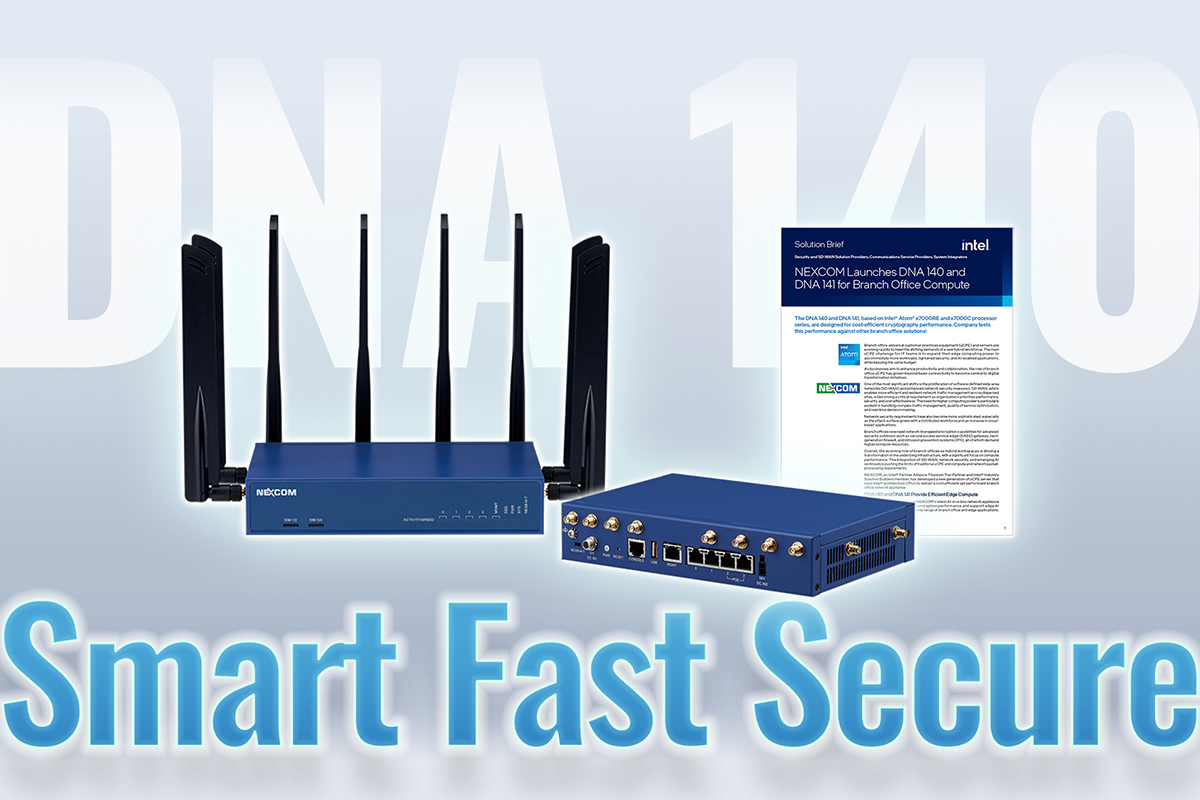
NEXCOM offers enterprise-grade SD-WAN solutions featuring the DNA 140 and DNA 141 appliances, designed to replace traditional branch office networking with cost-efficient, high-performance alternatives. Built on Intel architecture CPUs with advanced cryptographic capabilities, these platforms deliver simplified network management, reduced WAN costs, and enhanced security posture for distributed branch deployments. The DAN 140 and DNA 141 functions as a universal CPE (uCPE) enabling flexible application hosting across diverse SD-WAN software stacks, making it ideal for organizations modernizing their branch office infrastructure.
Problem / Requirements
Branch office networks face mounting operational challenges: legacy MPLS circuits consume substantial budget, on-site IT staff lack tools for effective security management, application performance suffers from indirect routing, and growing compliance requirements demand visibility into branch traffic. SD-WAN solutions address these requirements by:
- Eliminating dependency on expensive dedicated circuits
- Centralizing security policy enforcement across all branch locations
- Enabling direct Internet-based connectivity with controlled risk
- Providing real-time visibility and policy-based traffic steering
- Supporting simultaneous LTE/5G and broadband failover scenarios
Technical Approach
NEXCOM's SD-WAN platform combines software-defined networking principles with purpose-built hardware. The DNA 140 and DNA 141 appliances run on Intel Atom processors optimized for cryptographic operations, enabling high-throughput WAN encryption without performance penalties. The architecture separates control plane functions (centralized policy management) from data plane operations (local traffic steering), allowing administrators to define global policies while appliances make intelligent routing decisions based on application requirements, link quality, and security posture.
The DAN 140 and DNA 141 uCPE design enables hosted virtual network functions—including third-party SD-WAN controllers, security services, and application optimization—directly on the branch appliance. This consolidation reduces deployment footprint while maintaining operational flexibility across competing SD-WAN vendors.
/table
Challenge | Solution
High MPLS circuit costs | Direct Internet connectivity with encryption
Centralized management gaps | Unified policy control across all branches
Inconsistent security posture | Hardware-enforced cryptography at every site
Application performance degradation | Intelligent traffic steering based on application SLA
Vendor lock-in concerns | uCPE architecture supporting multiple SD-WAN stacks
/endtable
Implementation Notes
SD-WAN deployment typically begins with pilot branches, expanding to enterprise-wide rollout once policy templates are validated. NEXCOM appliances integrate with major SD-WAN controllers (Cisco Viptela, Versa, Fortinet, or open-source alternatives) through standard northbound APIs. The platform supports active-active dual-link configurations for high-availability deployments, with built-in failover logic prioritizing encrypted backup paths when primary WAN links degrade.
Branch administrators configure appliances through intuitive web consoles or centralized management platforms, eliminating the need for on-site networking expertise. QoS policies ensure critical applications (VoIP, video conferencing) maintain service levels despite competitive traffic flows. The hardware-based encryption support prevents security from becoming a performance bottleneck—a common limitation of software-only SD-WAN implementations.
Real-world deployments demonstrate that branch office modernization ROI materializes within 12 months: organizations typically save 35-50% on MPLS circuit costs while simultaneously improving application performance through intelligent path selection. Branch offices using the DNA 141 uCPE report 15-25% WAN bandwidth reduction through application optimization and compression features, further accelerating payback timelines.
Advanced deployments leverage the DNA 141's virtualization capabilities to consolidate multiple security appliances (firewall, antimalware, web content filtering) into a single platform, reducing power consumption and physical footprint. Organizations implementing network security consolidation report 60-70% reductions in branch office appliance counts, translating to simplified remote management and reduced hardware failure risks at geographically dispersed locations.
Specifications Snapshot
/table
Specification | Detail
Form Factor | Desktop appliance
Processors | Intel Atom architecture
Cryptography | Hardware-accelerated AES, IPSec
Deployment Model | Distributed branch offices
uCPE Capability | DAN 140 and DNA 141 supports virtual network functions
Management Interface | Web console + API for orchestration
Failover Support | Active-active multi-link configurations
WAN Types Supported | MPLS, broadband, LTE, 5G, direct Internet
/endtable
Key Takeaways
NEXCOM's SD-WAN solutions directly address the operational and financial constraints limiting branch office modernization. Unlike software-only alternatives, the hardware-optimized cryptography ensures security policies don't compromise application performance—a critical requirement for business continuity. The DAN 140 and DNA 141's uCPE design future-proofs investments by supporting multiple SD-WAN ecosystems, preventing organizations from committing exclusively to single vendors. For cost-conscious enterprises, ROI materializes within 6-12 months through reduced circuit costs and IT operational overhead.
The platform's architecture anticipates evolving branch office requirements. As 5G Fixed Wireless Access (FWA) matures, organizations can expand the DNA 140 portfolio with wireless modules, enabling seamless integration of FWA connectivity without replacing existing appliances. This forward-looking design reduces technology refresh cycles and protects previous infrastructure investments.
SD-WAN implementations also provide security visibility previously impossible with MPLS-only deployments. The centralized control plane offers security teams comprehensive traffic flow visibility across all branch locations simultaneously, enabling rapid detection and response to anomalous patterns indicating compromise or data exfiltration attempts. For organizations operating distributed networks, this centralized security analytics capability often justifies SD-WAN investments independent of cost savings.
Contact NEXCOM
For specifications, availability, and technical inquiries, contact NEXCOM via the official website.
Source: https://www.nexcom.com/news/Detail/sd-wan-solutions-to-build-a-safer-digital-branch-office-network