
Summary
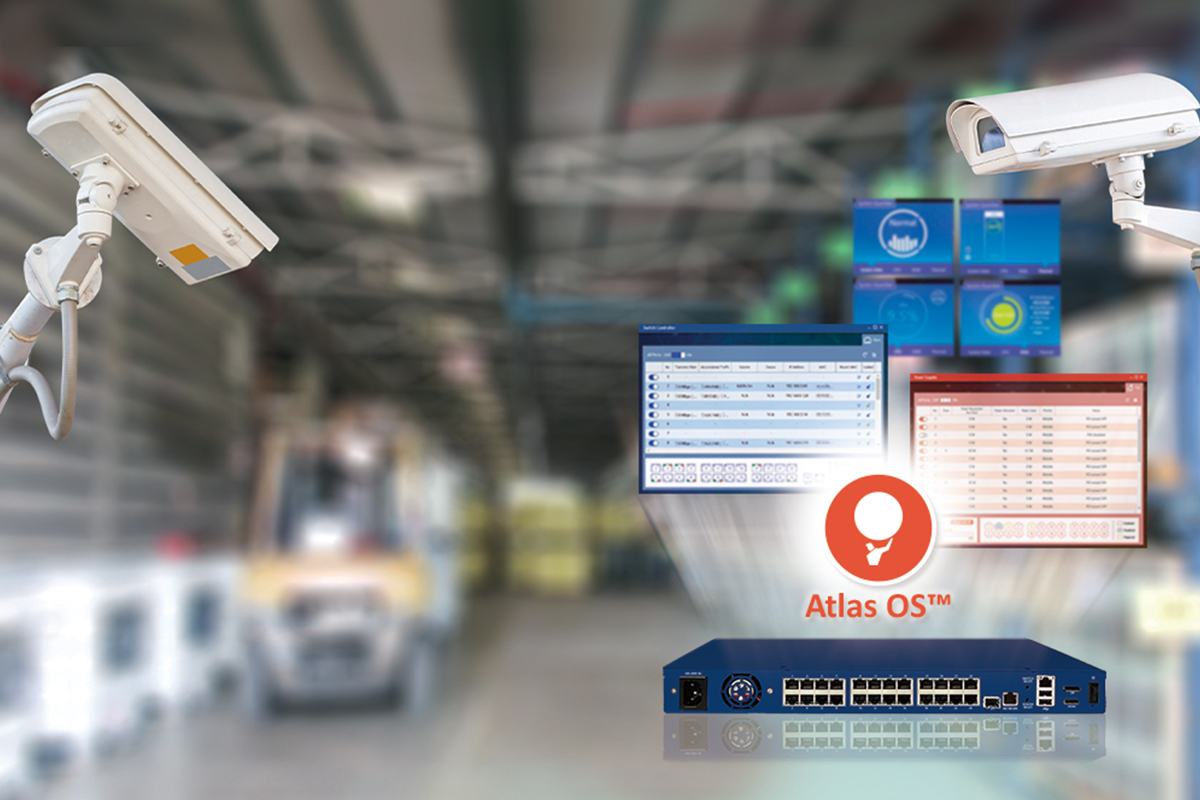
Network video recorder (NVR) systems serving mid-to-large surveillance deployments require integrated PoE power delivery, multi-camera support, and centralized storage management. NEXCOM's PNSA 3171 and PNSA 3171A NVR appliances address these requirements with built-in PoE switching, high-capacity storage expansion, and Atlas OS management software. The PNSA 3171 supports 8-channel IP camera systems, while the PNSA 3171A scales to 24 channels, both delivered as 1U rackmount appliances powered by Intel Core processors.
Problem / Requirements
Large-scale surveillance installations face several deployment challenges:
- PoE Integration: Delivering power and connectivity through unified infrastructure without separate power distribution
- Storage Expansion: Supporting multiple cameras with scalable 3.5" hard drive capacity and SSD caching
- Multi-Camera Management: Centralized monitoring, recording, and playback for 8 or 24 camera feeds
- Software Integration: API access for third-party NVR software integration and custom workflows
- Operational Efficiency: Simplified management interface reducing training overhead and deployment time
- Physical Constraints: 1U form factor for standard data center and telecom cabinet mounting
Technical Approach
/table
Challenge | Solution
Power delivery to distributed cameras | Integrated PoE switch with 8 or 24 ports
Storage scalability for HD/4K video | Four swappable 3.5" HDD bays + M.2 SSD slots
Multi-feed video processing | Intel Core processor with sufficient I/O bandwidth
Third-party NVR software compatibility | Atlas OS with published APIs and integration layer
System management accessibility | Web-based interface with PoE port control
Compact installation | 1U rackmount form factor
/endtable
The PNSA 3171-series appliances combine a managed PoE switch fabric with an onboard NVR compute engine. The processor runs NEXCOM's proprietary Atlas OS, which provides system-level video codec management, PoE switch port control, and storage allocation. Both models support hot-swappable storage, enabling rapid capacity expansion and drive replacement in operational deployments.
Implementation Notes
Specifications Snapshot
/table
Specification | PNSA 3171 | PNSA 3171A
PoE Switch Ports | 8 channels | 24 channels
IP Cameras Supported | Up to 8 | Up to 24
Processor | Intel Core | Intel Core
Storage (HDD) | 4x 3.5" swappable bays | 4x 3.5" swappable bays
SSD Slots | M.2 | M.2
Form Factor | 1U rackmount | 1U rackmount
Management | Atlas OS web interface | Atlas OS web interface
/endtable
Deployment Configuration
The PNSA series operates as both a switch and NVR platform. Cameras connect directly to PoE ports, which supply power (IEEE 802.3bt standard), data connectivity (1GbE uplink), and configuration routing. Storage allocation follows a tiered approach:
- Primary Recording: HDD bays configured in RAID for continuous stream archival
- Cache/Indexing: M.2 SSD for metadata, thumbnails, and rapid search acceleration
- Backup: Optional external storage via network connectivity
API integration enables:
- Custom Workflows: Integration with third-party NVR platforms (Hikvision, Milestone, Uniview)
- utomated Alerts: Motion detection and event-triggered actions
- Remote Playback: HTTP/HTTPS access for authorized users
- Analytics: Support for third-party video analytics plugins
Operational considerations:
- PoE Budget: Each appliance includes dedicated PoE power budget; high-power cameras may require stacking
- Network Topology: Dedicated uplink to core network to avoid bandwidth saturation
- Thermal Management: Passive cooling suitable for standard data center environments
- Redundancy: Multiple units in N+1 configuration for failover capability
Key Takeaways
1. Integrated PoE Delivery: Eliminates separate power infrastructure, reducing installation complexity and costs.
2. Scalability Options: PNSA 3171 (8-channel) and PNSA 3171A (24-channel) accommodate deployment growth from small to large installations.
3. Modular Storage: Hot-swappable HDD bays and M.2 SSD slots enable capacity scaling without system shutdown.
4. API Integration: Third-party NVR software compatibility through published interfaces supports mixed-vendor deployments.
5. Operational Efficiency: Web-based Atlas OS interface reduces management overhead and enables rapid troubleshooting.
Contact NEXCOM
For specifications, availability, and technical inquiries, contact NEXCOM via the official website.