Summary
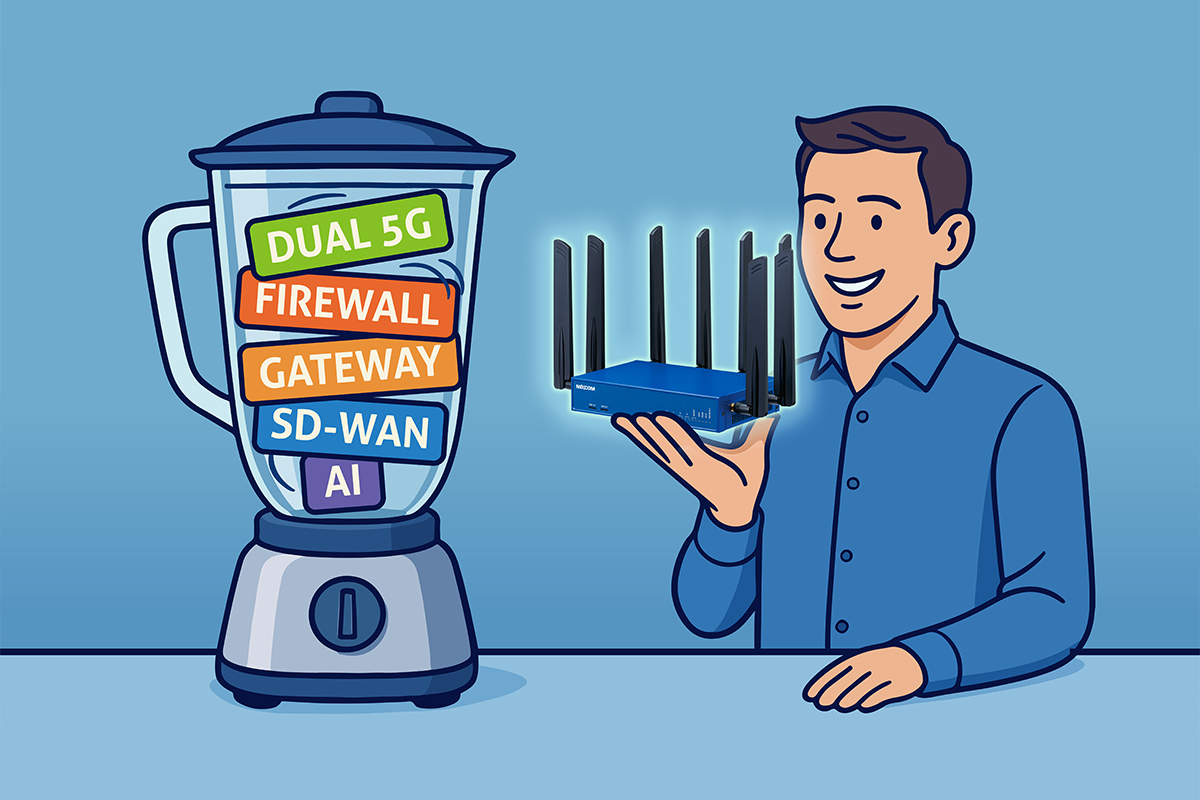
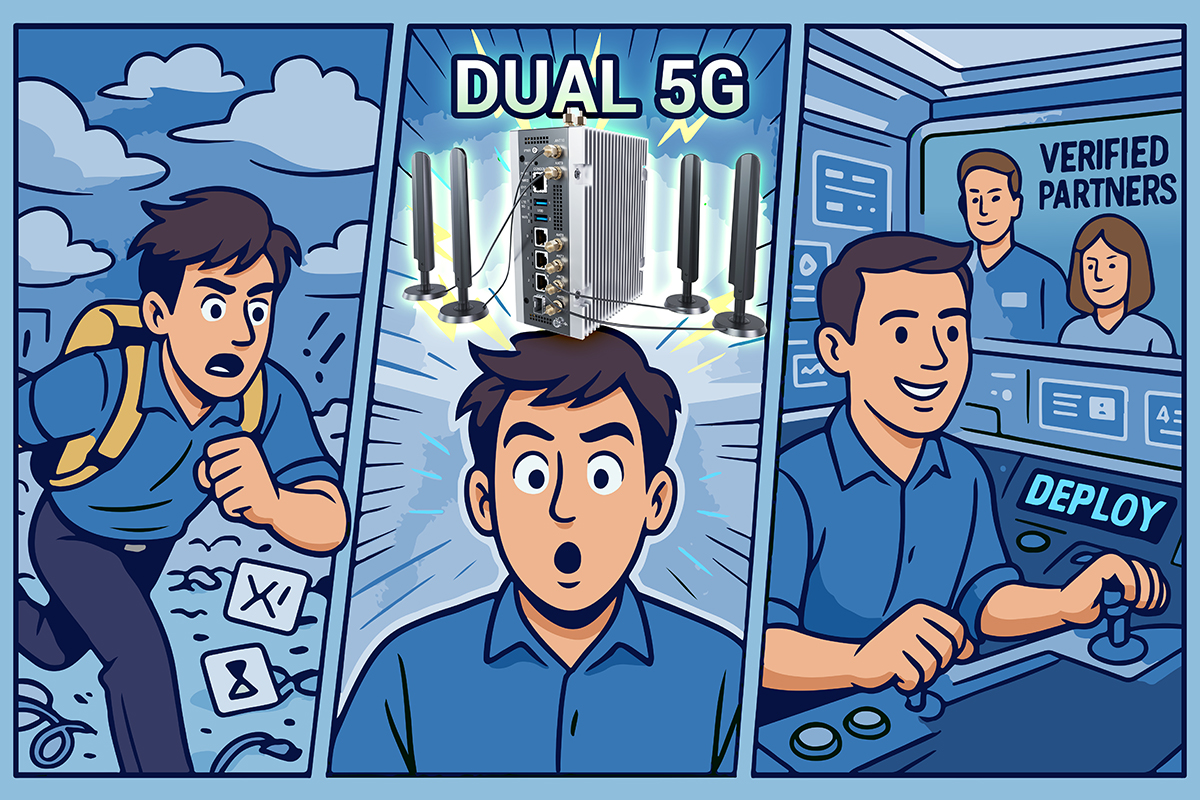
Critical infrastructure networks (electrical grids, water treatment, pipeline systems) cannot tolerate extended connectivity losses; a single communication link failure can cascade to cascading operational failures across distributed sites. NEXCOM's ISA 141 is a rugged dual-5G security router engineered for OT networks, integrating two independent 5G modules for simultaneous failover and network diversity, fanless design for harsh environments, DIN-rail mounting for seamless integration, and wide operating temperature tolerance (-20°C to 60°C). The ISA 141 enables critical infrastructure operators to maintain sub-second failover between redundant 5G carriers while applying consistent security policies across all network paths.
Problem / Requirements
Critical infrastructure operators face unforgiving constraints:
1. Single-Carrier Risk: Deploying one 5G carrier creates catastrophic single point of failure; network outages during carrier maintenance or service degradation disrupt critical operations.
2. Wide Temperature Environments: Substations, pump stations, and transmission towers operate in temperature ranges that destroy standard commercial networking equipment.
3. Harsh Physical Environments: Electromagnetic interference, voltage transients, salt spray, and dust require ruggedized mechanical and electrical design.
4. Regulatory Oversight: Operators must demonstrate redundancy and failover capability to grid operators and regulators; single-link deployments fail audit requirements.
5. Retrofit Constraints: Replacing existing industrial infrastructure is expensive; new connectivity solutions must integrate with legacy SCADA systems using standard protocols (Modbus, DNP3, IEC 60870-5-104).
Critical infrastructure networks default to expensive dedicated leased lines or accept regulatory non-compliance and operational risk.
Technical Approach
ISA 141 architecture provides redundancy at multiple levels:
Dual 5G Modules:
- Two independent 5G modules connect to different carriers or geographic locations
- Primary module handles normal operations; secondary module enters standby mode
- Carrier degradation detected within 100 ms; automatic failover transitions traffic to secondary module
- Both modules can operate simultaneously for load balancing (advanced deployment mode)
Redundancy Management:
- Active-active configuration: Split traffic across both 5G modules for throughput aggregation
- Active-standby configuration: Secondary carrier remains idle until primary fails
- Weighted failover: Route latency-sensitive traffic to dedicated carriers, bulk transfers to alternative link
- Cross-carrier failover: Seamless transition between Verizon, AT&T, T-Mobile, or international carriers
Fanless Rugged Design:
- Passive thermal design; no moving parts means higher reliability in temperature-extreme environments
- Industrial-grade shielding protects against EMI and RF interference
- Surge protection on all external connectors handles electrical transients and lightning strikes
- IP65 rating enables roof-mounted or outdoor deployment
OT Integration:
- DIN-rail mounting integrates directly into electrical cabinets alongside PLCs and SCADA controllers
- Serial ports (RS-232/485) support legacy protocol adapters for Modbus/DNP3 devices
- Transparent routing mode: Acts as simple gateway between local SCADA and carrier networks
- Stateful firewall enforcement blocks unauthorized SCADA commands across carrier links
Security Envelope:
- Encrypted tunnels (IPSec, L2TP) protect SCADA traffic from interception
- Rate limiting on critical protocols (DNP3 commands, Modbus requests) prevents brute-force attacks
- Audit logging of all WAN traffic for compliance and forensic analysis
- IEC 62443 aligned architecture separates SCADA control plane from management/monitoring traffic
Implementation Notes
Deployment Scenario: Electric Utility Substation
A 230kV substation operates SCADA systems monitoring circuit breakers, voltage regulators, and protection relays. The substation must maintain continuous connectivity to the utility control center (50+ miles distant) for:
- Real-time monitoring of protection relay status
- Remote tripping of breakers during fault conditions (critical safety function)
- Synchronized phasor (synchro) measurements for grid stability analysis
- Operational data logging and historical analysis
Previous Approach (Legacy):
- Expensive dedicated T1 leased line: $500-1000/month, limited to 1.5 Mbps
- Annual maintenance disruptions during carrier maintenance windows
- Single-link failure cascades to manual substation operation (reducing grid visibility)
ISA 141 Deployment:
- Primary 5G link: Verizon business account with guaranteed latency SLA
- Secondary 5G link: AT&T business account, geographic diversity (different cell tower)
- Sub-second failover: Primary link failure triggers automatic transition to AT&T within 100 ms
- SCADA connectivity: Transparent routing; SCADA control center unaware of failover
- Cost: $100-150/month aggregate (2x carrier accounts) with reliability SLA
- Bandwidth: 100+ Mbps available vs. 1.5 Mbps legacy link
Technical Configuration:
- Primary 5G module (Verizon): Handles real-time SCADA traffic (DNP3 commands, synchro measurements)
- Secondary 5G module (AT&T): Standby in passive mode; activated if primary link quality degrades >20% packet loss
- Encrypted tunnel: Both carriers route traffic through common VPN to utility data center
- Local aggregation: Substation gateway collects all legacy SCADA traffic (multiple devices) onto single encrypted carrier link
- Failover detection: ISA 141 monitors ping/keepalive; loss of 3 consecutive packets triggers failover
- Transparent operation: SCADA devices and control center require zero configuration changes
Performance Characteristics:
- Failover time: <500 ms (sub-second, acceptable for grid protection logic)
- Packet loss during failover: <10 consecutive packets (negligible for SCADA protocols)
- Latency: 50-100 ms typical (vs. leased line 20-30 ms, but well within SCADA tolerances)
- Throughput: 100+ Mbps per carrier (vs. 1.5 Mbps legacy)
- Temperature range: -20°C to 60°C (substation environments)
- Operating humidity: Up to 95% non-condensing (weatherproof deployments)
Challenge-Solution Mapping
Challenge | Requirement | NEXCOM Solution
Single 5G carrier failure | Automatic failover to second carrier | Dual independent 5G modules
Carrier-specific outages | Survive maintenance windows | Cross-carrier redundancy
Sub-second failover requirement | <500 ms transition | Autonomous monitoring + fast switchover
Temperature extremes (-20°C to 60°C) | Passive operation in harsh environments | Fanless design, industrial-grade components
Integration with legacy SCADA | Support Modbus/DNP3 without changes | Transparent routing, serial port adapters
Secure SCADA transmission | Encrypt traffic crossing carriers | IPSec tunnel with rate limiting
Geographic redundancy | Diverse physical location failover | Multi-carrier architecture
Field deployment without power | Operate in remote substations | Low power consumption + surge protection
Audit trail for regulatory | Document all WAN traffic | Comprehensive logging + event alerts
Specifications Snapshot
/table
Specification | Detail
5G Modules | Dual independent modules (primary + backup)
Failover Time | <500 ms (autonomous detection + switch)
Redundancy Modes | Active-active, active-standby, weighted failover
Network Throughput | 100+ Mbps per 5G module
OT Integration | Transparent routing, serial/Modbus adapters
Cooling | Fanless (passive thermal design)
Operating Temp | -20°C to 60°C (industrial-rated)
Form Factor | DIN-rail mountable, compact chassis
Security | IPSec tunnels, rate limiting, audit logging
Encryption Overhead | Sub-5% CPU impact via hardware acceleration
/endtable
Key Takeaways
1. Dual-Carrier Eliminates Single Point of Failure: Two independent 5G modules provide sub-second failover, satisfying regulatory redundancy requirements for critical infrastructure.
2. Fanless Design Ensures Reliability in Harsh Environments: No moving parts and industrial-grade components enable deployment in temperature-extreme substations and pump stations without thermal management concerns.
3. SCADA Transparency Simplifies Retrofit: ISA 141 acts as transparent gateway; existing SCADA systems, control centers, and operator interfaces require zero modifications.
4. Cost-Effective Redundancy vs. Leased Lines: Dual 5G carriers ($100-150/month) provide better redundancy, higher throughput, and faster failover than expensive dedicated leased lines ($500-1000/month).
Contact NEXCOM
For specifications, availability, and technical inquiries, contact NEXCOM via the official website.