
Summary
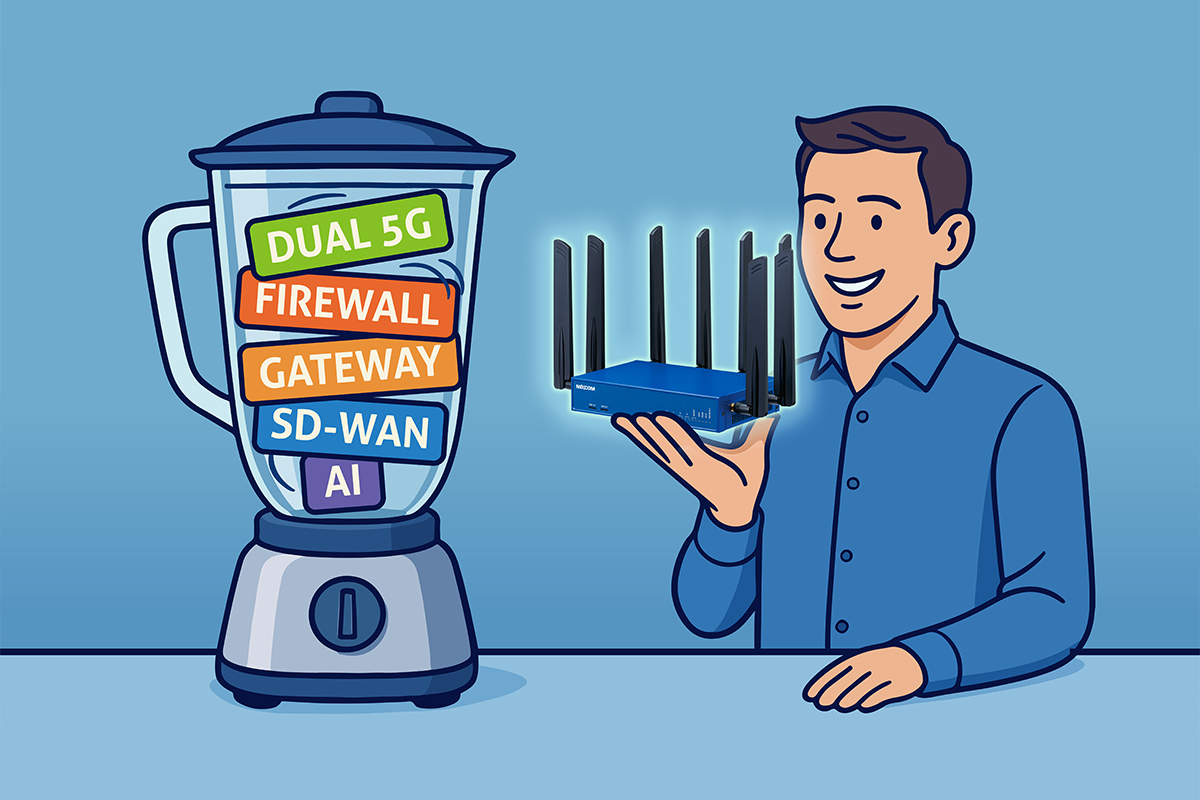
Next-Generation Firewalls excel at threat detection and protocol filtering, but modern edge networks demand more: simultaneous network optimization, wireless integration, multi-connectivity failover, and self-healing infrastructure. NEXCOM's DNA 140 converges NGFW protection, SD-WAN routing intelligence, dual 5G redundancy, and embedded AI into a single compact edge appliance. This integration eliminates the operational complexity of managing separate security and networking layers while delivering enterprise-grade resilience through built-in NEXBOOT™ platform recovery and modular AI acceleration.
Problem / Requirements
Modern branch offices and remote deployments face converging pressure
1. Multi-Connectivity Chaos: Employees access cloud services via Ethernet, Wi-Fi, and 5G simultaneously; one connection failure cascades to downstream applications.
2. Firewall Blind Spots: Traditional NGFW filters ports and protocols but lacks the network intelligence to route traffic optimally or detect anomalies across diverse connectivity paths.
3. Security-Performance Tradeoff: Adding security features (IPS, encryption, threat analysis) introduces latency and throughput penalties that degrade user experience.
4. Operational Complexity: Managing separate firewall, SD-WAN, and connectivity devices multiplies configuration overhead and increases failure modes.
Organizations either compromise security for performance or accept poor user experience and high operational costs.
Technical Approach
DNA 140 integrates four functional layers into a unified architecture:
NGFW Layer: Deep packet inspection with AI-assisted threat detection identifies zero-day attacks and sophisticated malware patterns that signature-based firewalls miss.
SD-WAN Layer: Dynamic path selection across multiple connection types (Ethernet, 5G, Wi-Fi) optimizes throughput and latency in real-time based on application requirements and network conditions.
Dual 5G/Failover Layer: Two independent 5G modules enable simultaneous connections to public and private networks or instant automatic failover if the primary connection degrades. This architecture eliminates single points of failure on remote links.
AI Acceleration Layer: Optional PCIe-based AI accelerator cards expand threat detection capabilities or enable edge analytics without relying on cloud-based security services.
NEXBOOT™ Platform Recovery: Autonomous system recovery with OS Round Robin and failover functions minimizes downtime and reduces IT team intervention.
Implementation Notes
Hardware Foundation:
- Intel Atom x7000RE/E/C Series: Low-power, fanless design suitable for unattended branch deployments
- TPM 2.0: Hardware-based secure key storage and cryptographic operations
- Modular design: PCIe slot for optional AI accelerator card expansion
- Multiple I/O options: PoE+ ports reduce power infrastructure requirements
Connectivity Architecture:
- Primary Path: Wired Ethernet (2.5GbE, multi-port) for consistent high-throughput corporate traffic
- Backup Path: First 5G module for failover; maintains connectivity if Ethernet fails
- Hybrid Path: Second 5G module connects to private network (e.g., MVNO or private 5G core), isolating sensitive traffic from public internet
- Wireless Extension: Wi-Fi module expands coverage to areas where wired infrastructure unavailable
Security Policy Enforcement:
- Traffic inspection rules applied consistently across all connection types
- Encrypted tunnels isolated from cleartext traffic via VLAN segmentation
- PoE+ power supply integration for IP cameras, VoIP phones, and wireless APs eliminates separate power infrastructure
Recovery & Resilience:
- NEXBOOT™ monitors system health; if OS instability detected, automatically reverts to previous stable state
- Dual-boot OS configuration ensures one partition always remains clean
- Failover triggers automatically on connection loss (sub-second detection/recovery)
Challenge-Solution Mapping
/table
Challenge | Requirement | NEXCOM Solution
Single firewall cannot optimize routing | Dynamic path selection across 3+ connections | SD-WAN intelligence layer in DNA 140
Connectivity failover is manual | Automatic sub-second failover on link loss | Dual 5G modules with hot-standby
NGFW adds latency to encrypted traffic | Security without throughput penalty | Hardware offload paths for policy enforcement
Separate devices multiply configuration | Single unified appliance for security + routing | Integrated NGFW + SD-WAN + 5G in one chassis
System failures disrupt branch operations | Rapid recovery from OS/software faults | NEXBOOT™ autonomous recovery system
Private network isolation difficult | Simultaneous public + private 5G access | Dual 5G modules with network segregation
Branch power infrastructure limited | Power management for accessories | PoE+ output ports (802.3at, 30W per port)
/endtable
Specifications Snapshot
/table
Specification | Detail
Processor | Intel Atom x7000RE/E/C Series
Wired Connectivity| 4x 2.5GbE RJ45 LAN ports
PoE+ Output | 2x 802.3at ports (30W per port)
5G/LTE Support | Dual modules (primary + failover/hybrid)
Wi-Fi Support | Optional 802.11ax integration
Security | TPM 2.0, hardware key storage
AI Acceleration | PCIe slot for optional accelerator card
Platform Recovery | NEXBOOT™ with OS Round Robin failover
Operating Temp | 0°C~40°C
Form Factor | Compact edge appliance (fanless)
/endtable
Key Takeaways
1. NGFW Is Infrastructure, Not Solution* Pure firewall protection addresses only the threat layer; modern branch networks require simultaneous optimization, redundancy, and self-healing.
2. Dual 5G Eliminates Single Points of Failure: One 5G link acts as backup; the second link can serve private networks or carry latency-sensitive applications independently.
3. Converged Architecture Reduces Operational Burden: Unified NGFW + SD-WAN + 5G appliance lowers configuration complexity and reduces the number of devices requiring monitoring and updates.
4. NEXBOOT™ Reduces Unplanned Downtime: Autonomous platform recovery ensures branch offices recover from software faults without IT team intervention, critical for unattended deployments.
Contact NEXCOM
For specifications, availability, and technical inquiries, contact NEXCOM via the official website.