The scariest AI in your organization may be the one nobody knows about.
It usually starts innocently, just like every good horror story… An employee needs to summarize a report, analyze a spreadsheet, translate a document, or solve a stubborn coding problem. The company's approved AI tool isn't quite what they need, so they open another one. A few clicks later, the job is done. Woohoo!
Nothing seems wrong. And that is exactly what makes it frightening. Somewhere in the corporate network, an AI connection is quietly exchanging data beyond the company’s security boundaries.
Trick or treat? What looked like a treat for employees was actually the trick for cybersecurity. Behind those innocent clicks, a new kind of threat has slipped into the network... A threat that barely existed in our security conversations just a few years ago: Shadow AI.
And that's where our little Halloween story gets spooky.
A Dark Shadow Is Looming Over Your Network
Generative AI taught us to ask machines for answers. Agentic AI is teaching them to take action.
“Dear MIS team, please forgive us. We couldn't resist AI's charm. It was fast, helpful, and, apparently, very good at getting invited inside. Even IT professionals, who should know better than anyone, can fall under its spell.” [1] [2] [3]
An AI agent can read files, call APIs, access applications, execute tasks, and move between systems on a user's behalf. The more access it has, the more it can do, from answering a question to taking action across the systems that keep a business running.
AI is becoming embedded in the way work gets done, and with every new AI-powered tool, integration, and agent, another connection appears for security teams to understand. An AI coding assistant slips into a developer's workflow. An agent gets access to internal files to complete a task. A SaaS platform quietly adds an AI feature. Another team signs up for a different service because it “just works better.”
What can it access? Where can it go? What data can it take with it? Andwhat happens when it starts making decisions on its own? Suddenly, there aremore questions than anyone has answers for. Houston,we actually have a problem here.
You may have policies for approved AI tools. You may have firewalls, identity controls, and endpoint security in place. But if you cannot see every AI connection and control what it can reach, there may already be a gap between what your security policy says and what your network is actually doing.
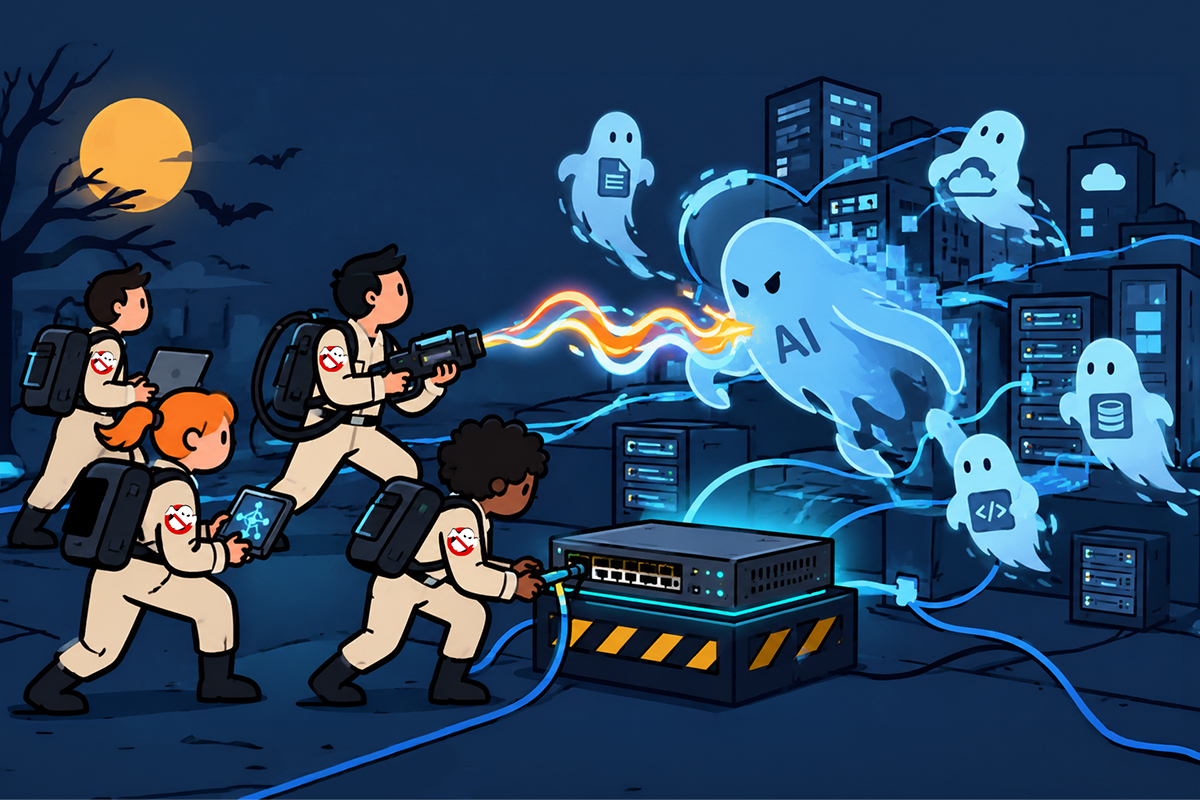
It’s Time for Some Ghostbusting
So, how do you “ghostbust” Shadow AI? Not by chasing every AI tool out of the building. Definitely not. That battle may already be lost. The real solution is to make your network SEE what’s happening, UNDERSTAND the connections, and CONTROL where they can go.
And this is where NEXCOM shows up with the “ghostbusting” gear.
Intelligent routing, secure gateways, cybersecurity, edge computing, and flexible connectivity give organizations the visibility and control to keep AI connections on the right paths and away from the places they shouldn't be.
Better yet, AI doesn't always need to disappear into some mysterious cloud. Local LLMs and enterprise AI agents can run on NEXCOM security appliances, keeping AI closer to the data, applications, and systems it needs to work with.
We’re not here to scare you. We’re just giving you something to think about: what’s moving through your network that you may not be seeing? Because when AI starts casting shadows across your network, you better have your ghostbusters ready at the edge. And NEXCOM is already there, with the security gear ready to do what it does best: keep the network ghost-free.
P.S. This isn't just Halloween fiction. The UK's National Cyber Security Centre (NCSC) recently highlighted Shadow AI as a growing security challenge, warning that organizations can lose visibility and control over their data when employees use unapproved AI services. Australia's National AI Centre is addressing the same issue, defining Shadow AI as the use of AI tools outside an organization's official policy or approved approach.
Different countries, same dark shadow... Take action before it spreads across your network.